
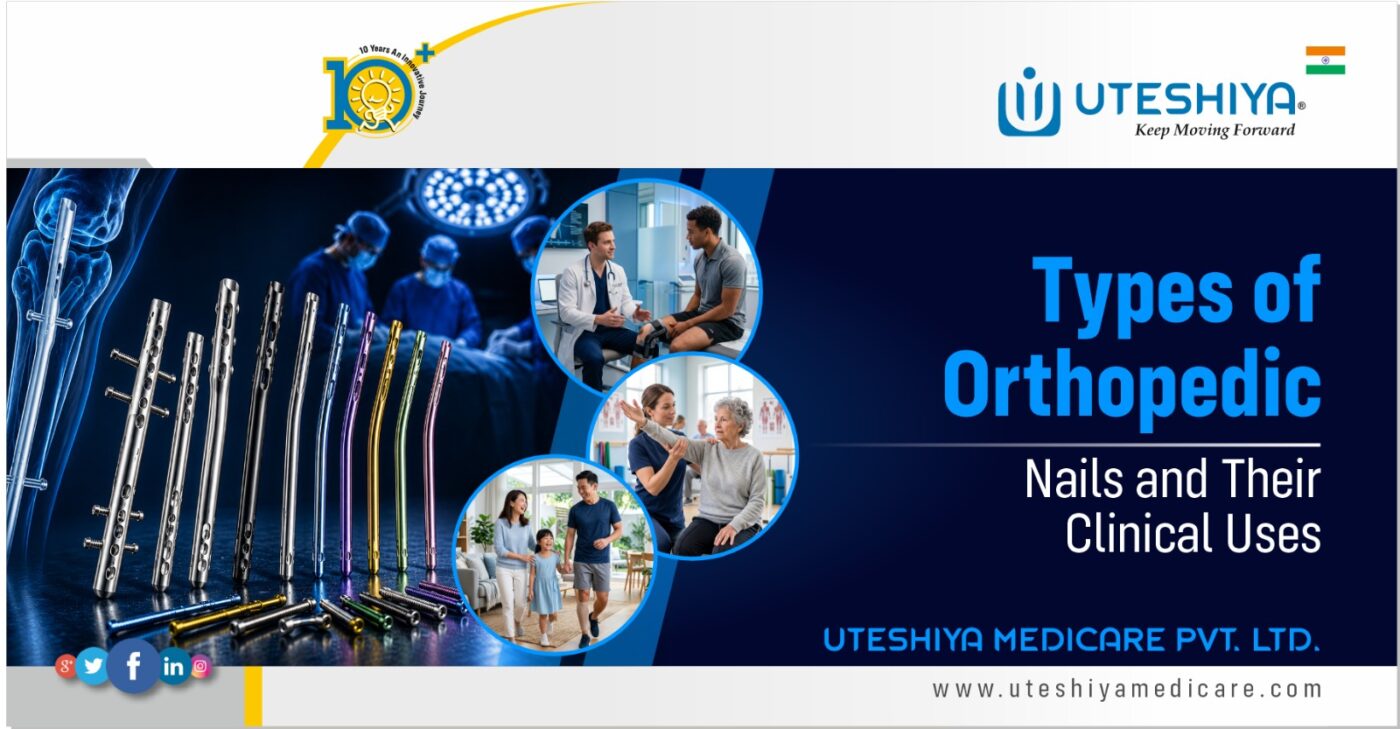
Bone fractures involving long bones often require strong internal support to maintain alignment during healing. Among the most widely used fixation methods in orthopedic trauma surgery are intramedullary nails, commonly called orthopedic nails. These implants are inserted inside the medullary canal of the bone to stabilize fractures while allowing controlled load sharing during recovery.
Intramedullary fixation is commonly used for fractures of the femur, tibia, humerus, and forearm bones because it provides strong mechanical stability with smaller surgical exposure compared to some plating procedures.
Modern orthopedic nails are available in different designs based on fracture location, patient age, bone anatomy, and fixation requirements. Advances in nail technology have also improved surgical precision, implant durability, and postoperative recovery outcomes.
What Are Orthopedic Nails?
Orthopedic nails are long metallic implants inserted into the hollow canal of long bones to stabilize fractures internally. They are usually made from titanium or stainless steel and are designed to support alignment while the bone heals naturally. These implants are commonly referred to as intramedullary nails or IM nails.
Unlike traditional plates fixed on the outer bone surface, orthopedic nails function from inside the bone, which helps preserve surrounding soft tissues and improves load distribution during movement.
How Intramedullary Nails Work
Intramedullary nails act as internal splints placed within the bone canal. Once inserted, locking screws are often added at both ends of the nail to prevent rotation and shortening of the fractured bone. This fixation method provides stability while allowing controlled micro-motion that supports callus formation and fracture healing.
These nails are widely used in shaft fractures because they provide strong fixation with relatively smaller incisions and less disruption of fracture biology.
Main Types of Orthopedic Nails
Different nail systems are designed for specific bones and fracture patterns.
Femoral Nails
Femoral nails are used for fractures involving the shaft or proximal region of the femur. These nails are available in antegrade and retrograde designs depending on the insertion point and fracture location. They are commonly used in high-energy trauma, segmental fractures, and complex femoral injuries.
Tibial Nails
Tibial intramedullary nails are used for fractures of the tibial shaft and selected proximal or distal tibia fractures. Modern tibial nails support multiple locking screw options for improved fixation in difficult fracture patterns.
Humerus Nails
Humerus nails stabilize fractures involving the upper arm bone. These implants are commonly used in shaft fractures and selected proximal humerus fractures where minimally invasive fixation is preferred.
Elastic Nails
Elastic nails are frequently used in pediatric orthopedic surgery because they accommodate growing bones while providing flexible stabilization. Titanium Elastic Nailing Systems are widely used for pediatric femur and forearm fractures.
Interlocking Nails
Interlocking nails contain proximal and distal locking screw mechanisms that improve rotational and axial stability. These nails are widely used for unstable fractures, comminuted fractures, and long bone injuries.
Reconstruction Nails
These specialized nails are designed for fractures involving the femoral neck and shaft simultaneously. Additional screw options support fixation into the femoral head and neck region.
Cephalomedullary Nails
Cephalomedullary nails are commonly used in proximal femur fractures, such as intertrochanteric fractures. These nails provide stable fixation for hip fracture management, especially in elderly patients.
Classification Based on Insertion Technique
Orthopedic nails can also be classified according to insertion direction.
| Nail Type | Insertion Direction | Common Use |
| Antegrade Nail | Proximal to distal | Femur and tibia shaft fractures |
| Retrograde Nail | Distal to proximal | Distal femur fractures |
| Flexible Nail | Elastic stabilization | Pediatric fractures |
| Locked Nail | Locking screws added | Unstable fractures |
What are the advantages of Orthopedic Nails?
Intramedullary nails offer several important clinical benefits.
- Compared to some open plating procedures, intramedullary nailing usually requires smaller incisions and reduced soft tissue disruption.
- Because the implant is positioned inside the bone canal, forces are distributed more naturally during movement and weight bearing.
- Many patients can begin controlled movement and rehabilitation earlier, depending on fracture type and fixation stability.
- Intramedullary fixation helps preserve periosteal circulation because the fracture site often requires less direct exposure during surgery.
- Interlocking nail systems provide good fixation for comminuted, segmental, and unstable long bone fractures.
Common Clinical Applications
Orthopedic nails are widely used in trauma and reconstructive procedures, such as those mentioned here.
- Femoral shaft fractures
- Tibial shaft fractures
- Hip fractures
- Humerus fractures
- Pediatric long bone fractures
- Segmental fractures
- Pathological fractures
- Nonunion and malunion procedures
Possible Complications
Although orthopedic nails are highly effective, complications may still occur in certain cases.
- Postoperative infection remains a concern in all orthopedic fixation procedures.
- Improper stability or poor biological healing conditions may affect fracture union.
- Mechanical failure can occur due to excessive loading or incomplete healing.
- Improper nail positioning may result in rotational or angular deformities.
- Some patients experience irritation around the insertion site depending on the surgical approach.
Why Some Fractures Need Stronger Fixation
Long bone fractures are not always simple to manage, especially in cases involving multiple fragments, severe trauma, or weak bone quality. Maintaining proper alignment during healing becomes more difficult when the fracture is unstable or located near joints. In such situations, strong internal fixation becomes important to prevent shortening, rotational deformity, or delayed healing.
Orthopedic nails are widely used in these complex cases because they provide internal support through the center of the bone while maintaining better mechanical balance during movement. Their load-sharing design helps reduce excessive stress on the fracture site and supports gradual healing during rehabilitation.
In modern trauma surgery, orthopedic nails are commonly preferred for high-energy injuries because they allow stable fixation with smaller incisions and less disturbance to surrounding soft tissues.
Conditions Where Orthopedic Nails Are Commonly Used
- Road accident and trauma fractures
- Comminuted long bone fractures
- Osteoporotic bone injuries
- Segmental and unstable fractures
- Certain sports-related fractures
Wrapping It Up
Orthopedic nails remain one of the most effective fixation solutions for long bone fractures. Their ability to provide stable internal support while preserving surrounding tissues makes them widely used in modern trauma surgery. With continuous advancements in implant design and surgical techniques, orthopedic nail systems continue to improve fracture management, recovery support, and long-term clinical outcomes.
