
Clavicle fracture treatment has improved significantly with advancements in orthopedic implants, yet lateral clavicle fractures continue to present challenges for surgeons. These injuries are more common than many assume—clavicle fractures account for nearly 2.6% to 10% of all fractures and up to 44% of shoulder-related injuries, making them a frequent concern in orthopedic practice.
The annual incidence is estimated at 29 to 64 cases per 100,000 people, with recent studies reporting figures as high as 82 per 100,000 person-years, showing a steady rise over time.
Despite their frequency, lateral clavicle fractures remain particularly complex. These fractures, especially those involving the acromioclavicular (AC) joint, are prone to instability due to ligament disruption and small distal bone fragments.
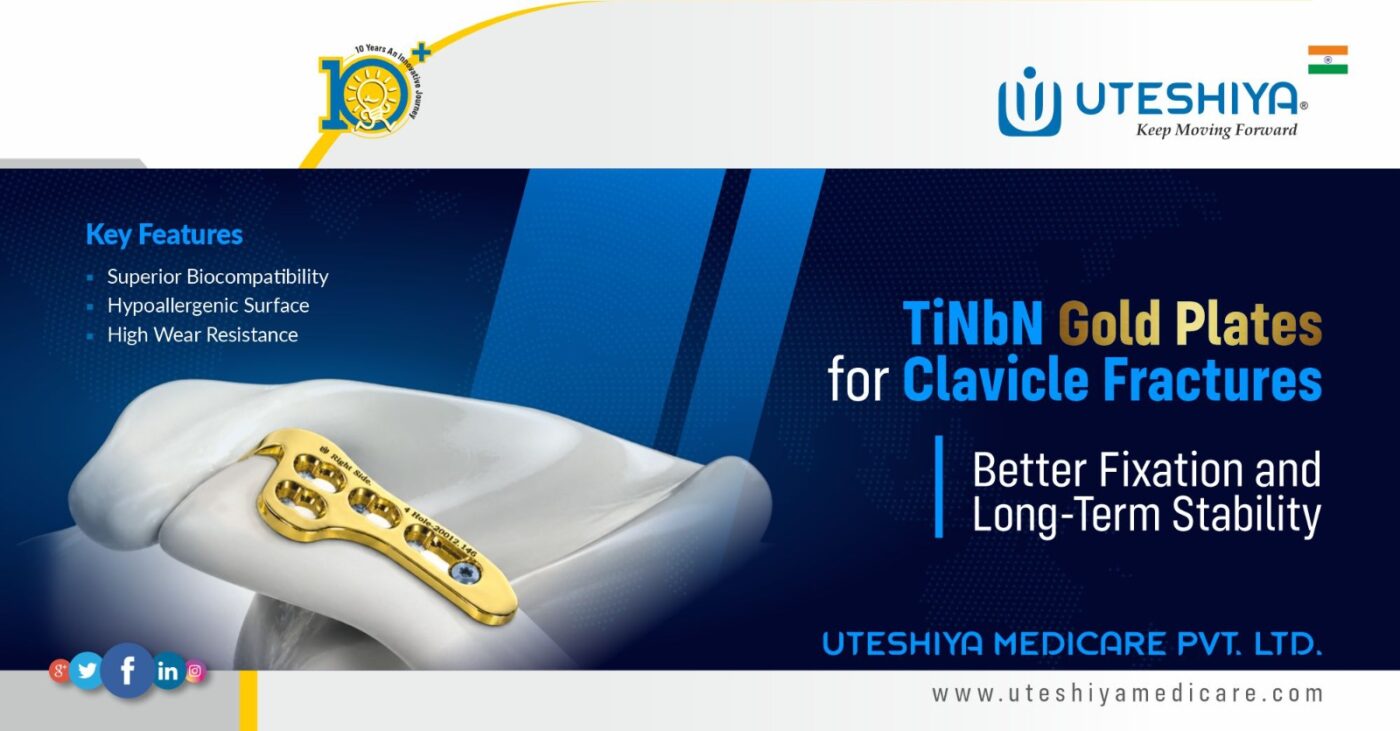
In such cases, implant selection becomes critical not just for fixation but also for long-term performance within the body. This is where TiNbN gold surface plates offer a more refined solution. Designed to improve surface strength, reduce wear, and enhance biological compatibility, these plates address several limitations of conventional implants.
Why Lateral Clavicle Fractures Are More Complex
Not all clavicle fractures behave the same way. Midshaft fractures are relatively straightforward, but lateral fractures are mechanically unstable.
This instability occurs for the reasons below.
- The distal fragment is often small and difficult to secure
- Ligament attachments (like coracoclavicular ligaments) are disrupted
- Muscle forces tend to displace the fracture
As a result, standard fixation methods may not always provide reliable stability. Surgeons need implants that can maintain alignment under continuous stress while allowing early shoulder movement.
The Role of Locking Compression Plates
Locking compression plates are commonly used for clavicle fixation due to their ability to provide angular stability. Unlike traditional plates, they do not rely entirely on bone quality, which makes them useful in complex fracture patterns.
However, the performance of these plates depends heavily on their surface properties. Over time, issues such as wear, irritation, or metal sensitivity can affect outcomes.
This is where surface-enhanced implants make a noticeable difference.
What Makes TiNbN Gold Surface Plates Different
TiNbN (Titanium Niobium Nitride) is a specialized coating applied to orthopedic implants to improve their surface characteristics. The gold appearance is simply a result of this coating; it reflects function rather than material composition.
The coating forms a thin, hard layer over the implant, enhancing its resistance to wear and corrosion while maintaining the structural strength of the base material.
More importantly, it acts as a protective interface between the implant and surrounding biological tissue.
Key Benefits That Matter in Real Cases
Better Biocompatibility
Implants remain inside the body for extended periods, so how the body responds to them matters. TiNbN-coated plates are designed to reduce adverse tissue reactions and support smoother integration with surrounding structures. This becomes especially useful in patients with sensitivity to certain metals.
Reduced Risk of Allergic Response
Metal allergies, particularly related to nickel, can lead to complications such as inflammation or discomfort. The TiNbN layer limits direct exposure to underlying metals, making it a safer option for sensitive patients.
Higher Wear Resistance
The clavicle is constantly involved in upper limb movement. Over time, this can lead to micro-wear in standard implants. TiNbN coating significantly improves surface hardness, helping the implant maintain its integrity even under repeated stress.
Improved Durability Without Compromising Flexibility
An ideal implant needs to be strong but not overly rigid. TiNbN coating enhances durability while preserving the mechanical behavior required for effective fixation.
Smoother Surface Interaction
A refined surface reduces friction against surrounding tissues. This can contribute to improved post-operative comfort and lower chances of soft tissue irritation.
Practical Benefits in Surgical Use
From a surgical perspective, consistency and predictability are key.
With advanced surface-coated plates-
- Screw locking remains stable under load.
- Plate integrity is maintained over time.
- Handling during surgery remains familiar.
- Outcomes are more consistent across different fracture types.
This reduces intraoperative challenges and supports better post-operative results.
Post-Surgery Recovery and Patient Comfort
Recovery after clavicle fixation depends not just on surgical technique, but also on how the implant behaves during healing. Plates with improved surface properties support a smoother recovery, especially for active patients.
TiNbN-coated plates help reduce soft tissue irritation due to their refined surface. This is important in the clavicle region, where implants sit close to the skin and can be felt during movement. Patients generally experience better comfort in the early stages.
- Reduced irritation near the implant site
- More stable fixation during healing
- Lower chances of surface wear issues
- Supports early shoulder movement
These factors help maintain alignment and allow controlled rehabilitation without putting excess stress on the fracture site.
Comparison with Conventional Plates
| Aspect | Conventional Plates | TiNbN Gold Plates |
| Surface Protection | Basic | Advanced coated layer |
| Wear Resistance | Moderate | High |
| Allergy Risk | Present in some cases | Significantly reduced |
| Durability | Standard | Improved |
| Tissue Interaction | Normal | Smoother and refined |
This difference becomes more noticeable in long-term outcomes rather than immediate fixation.
Where Products Like Uteshiya Fit In
Implants designed with TiNbN coating, such as those developed by Uteshiya, are built specifically to address real surgical challenges rather than just theoretical improvements.
The focus is not only on fixation strength, but also on how the implant performs over time inside the body. This balance between mechanical reliability and biological compatibility is what makes these solutions more practical in demanding cases.
Better Clavicle Fixation with TiNbN Gold Plates
Surface engineering in orthopedic implants is moving toward improving both performance and patient comfort. Coatings like TiNbN are a step in that direction, offering measurable benefits without changing the surgical approach. Future developments are likely to focus on these, as mentioned below.
- Further reducing implant-related complications.
- Enhancing long-term stability
- Supporting faster functional recovery
As these improvements continue, surface-treated implants are expected to become a more common choice in fracture management.
Wrapping It Up
Lateral clavicle fractures and AC joint dislocations require precise and stable fixation. While traditional plates provide structural support, surface-enhanced options such as TiNbN gold plates add a layer of reliability.
By improving wear resistance, reducing the risk of allergic reactions, and enhancing overall durability, these plates support better surgical outcomes and patient comfort over time. For surgeons seeking consistent fixation and patients expecting long-term performance, this approach offers a practical, well-balanced solution.
