
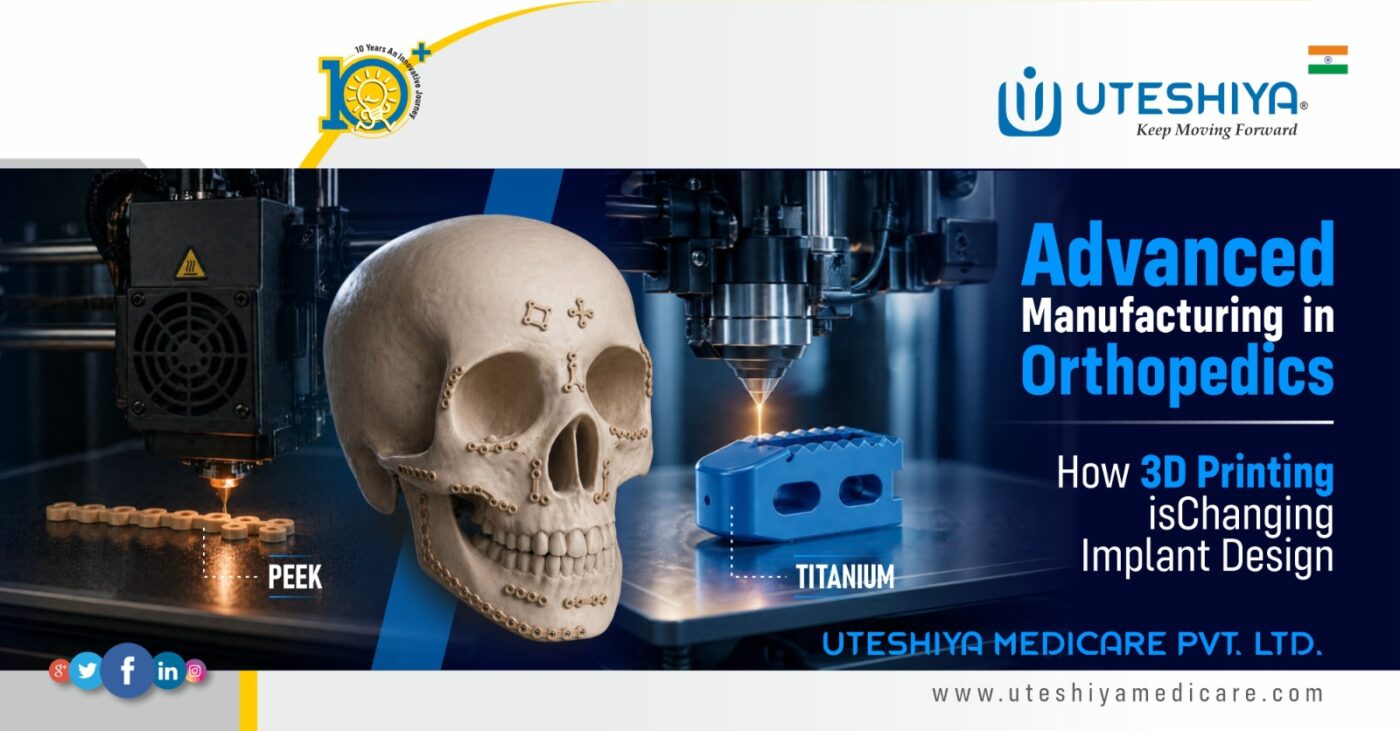
Orthopedic implant manufacturing has undergone a major shift with the adoption of additive manufacturing, commonly known as 3D printing. Traditional implant production relied on standardized designs and subtractive manufacturing processes, which limited customization and increased material waste. Today, 3D printing enables the production of highly precise, patient-specific implants that align closely with individual anatomy.
The impact of this shift is significant. The International 3D printing medical implants market was valued at approximately $2.66 billion in 2025 and is projected to reach approximately $9.81 billion by 2034, growing at a steady annual rate of nearly 16%. This growth reflects increasing demand for personalized healthcare solutions and improved surgical outcomes.
What Is 3D Printing in Orthopedic Implants?
3D printing in orthopedics refers to the layer-by-layer fabrication of implants using digital models. These models are typically created from patient imaging data such as CT or MRI scans, allowing implants to match the exact anatomical structure.
Unlike conventional methods that shape implants by cutting or molding materials, additive manufacturing builds the implant from scratch. This allows for complex geometries that were previously difficult or impossible to achieve.
As a result, orthopedic implants are no longer limited to standard sizes. Instead, they can be tailored to individual patients, improving fit, stability, and long-term performance.
Why Traditional Implant Manufacturing Had Limitations
Before the introduction of 3D printing, most implants were produced in fixed sizes and shapes. Surgeons often had to select the closest available option, which did not always provide an ideal fit.
This led to several challenges, such as-
- Increased surgical time due to adjustments during procedures
- Higher risk of implant misalignment
- Greater likelihood of revision surgeries
- Material wastage during manufacturing
These limitations created a need for more flexible and precise manufacturing solutions.
Advantages of 3D Printing in Orthopedic Implants
Patient-Specific Customization
One of the most important advantages is the ability to design implants based on the patient’s anatomy. This improves implant fit and reduces complications associated with mismatched sizing.
Complex Design Capability
3D printing allows the creation of intricate structures, such as porous surfaces that support bone growth. These designs enhance implant stability and integration with surrounding tissue.
Reduced Surgical Time
Customized implants and surgical guides improve accuracy during procedures. Studies show that this can reduce operating time and improve precision.
Material Efficiency
Additive manufacturing uses only the required material, reducing waste compared to traditional subtractive methods.
Faster Production Cycle
Digital workflows allow quicker design and manufacturing, which is particularly useful in complex or urgent cases.
Materials Used in 3D Printed Orthopedic Implants
The material used in an implant directly affects how well it performs inside the body. Some materials are better suited for strength, while others support bone integration or flexibility.
- Titanium alloys – Widely used for strength, durability, and biocompatibility
- Cobalt-chromium alloys – Suitable for load-bearing implants
- Bioceramics – Used for bone regeneration and surface coatings
- Polymers – Used in specific non-load-bearing applications
These materials are selected based on the type of implant and clinical requirements. Advances in material science continue to improve implant safety and performance.
Applications of 3D Printing in Orthopedics
3D printing is now widely used across different orthopedic procedures.
Joint Replacement Implants
Custom hip and knee implants provide better alignment and reduce wear over time.
Spinal Implants
Patient-specific spinal cages and fixation devices improve stability and surgical outcomes.
Trauma and Reconstruction
Complex fractures can be treated with implants designed specifically for the patient’s bone structure.
Surgical Planning Tools
3D printed models help surgeons plan procedures more accurately, reducing intraoperative uncertainty.
Market Growth and Industry Trends
The adoption of 3D printing in orthopedics is increasing rapidly due to technological advancements and growing clinical demand. Increasing cases of orthopedic conditions, aging populations, and the need for improved surgical outcomes drive this growth.
- The orthopedic 3D printing devices market is projected to reach around $6.8 billion by 2034
- The broader 3D printed orthopedic implants market is expected to grow at over 19% annually.
- Orthopedics accounts for a major share of 3D printed medical implants, contributing over 50% of applications.
How Digital Workflow Supports Implant Manufacturing
One of the main advantages of 3D printing is how easily it works with digital tools. The process usually involves the following steps.
- Medical imaging (CT/MRI scans)
- Digital modeling and design
- Simulation and testing
- Layer-by-layer manufacturing
This digital workflow reduces errors and ensures consistency in implant production. It also allows for easier modifications and faster iteration during the design process.
Clinical Benefits for Patients
From a patient perspective, 3D printed implants offer several advantages. Improved implant fit leads to better comfort and function after surgery. Reduced surgical time lowers the risk of complications. Enhanced bone integration improves long-term stability and reduces the likelihood of revision procedures.
In many cases, patients experience faster recovery due to improved surgical precision and implant performance.
Role of 3D Printing in Reducing Implant Failure
One of the important benefits of 3D printing in orthopedics is its role in reducing implant failure over time. In traditional implants, mismatched sizing or improper alignment can lead to stress on surrounding bone and tissues. This may result in loosening, discomfort, or the need for revision surgery.
With 3D printing, implants are designed to match the patient’s anatomy more accurately. This improves how the implant sits within the body and distributes load more evenly. As a result, there is less stress on joints and surrounding structures.
This improvement is mainly due to a few key factors.
- Better anatomical fit, which reduces uneven pressure on the joint
- Improved load distribution, helping the implant handle movement more naturally
- Porous surface design that supports bone growth into the implant
- More accurate placement during surgery with the help of 3D planning
- Reduced chances of loosening over time
Another advantage is the ability to create surface textures that support better bone attachment. These designs allow stronger bonding between the implant and bone, improving long-term stability.
Overall, improved fit, better integration, and precise placement together help lower the risk of complications and improve implant lifespan.
Wrapping It Up
3D printing is redefining how orthopedic implants are designed and manufactured. By enabling customization, improving surgical accuracy, and reducing production limitations, it addresses many of the challenges associated with traditional methods.
While there are still barriers related to cost, regulation, and expertise, ongoing advancements are making the technology more accessible and practical. As adoption continues to grow, 3D printing is expected to become a standard approach in orthopedic implant manufacturing, improving both clinical outcomes and patient experience.
