
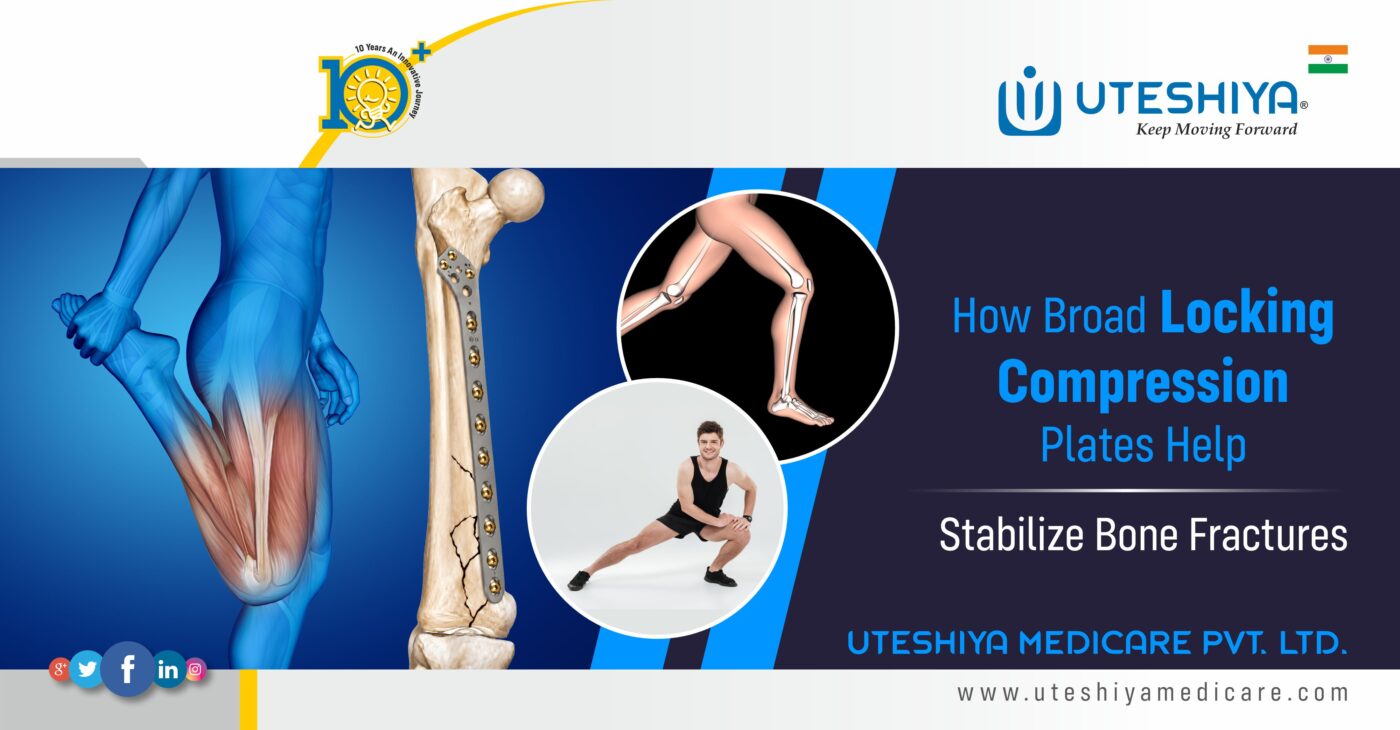
What happens when a broken bone needs more support than a cast can provide? For certain long-bone fractures, surgery may be needed to hold the broken ends in the correct position while the bone heals. A broad locking compression plate is one option surgeons use to stabilise suitable fractures. Fixed to the bone with screws, it can help maintain alignment and create compression between fracture fragments when the injury pattern allows. The choice of plate depends on the bone involved, the type of fracture, and the stability needed during healing.
What Is a Broad Locking Compression Plate?
A broad locking compression plate is a wider version of a locking compression plate (LCP), used in selected long-bone fracture procedures. It is attached to the bone with screws and provides support while the fracture heals.
A broad locking compression plate has specially designed holes that can accept conventional screws or locking screws, depending on the plate system. Conventional screws can create compression between suitable fracture fragments when inserted in the compression portion of a hole. Locking screws thread into the plate to form a fixed-angle connection, helping maintain fracture alignment and fixation stability.
The wider design is suited to certain larger bones and fracture patterns where the required plate dimensions and fixation strength call for a broad plate. It is not the right choice for every fracture, and a wider plate does not automatically produce better healing.
How Does the Plate Help a Broken Bone Heal?
1. It Holds the Bone Fragments in Position
After a fracture, the broken ends must be aligned and stabilised. Movement at the fracture site that exceeds what the healing process can tolerate may interfere with bone repair.
A broad compression plate is secured to the bone with screws, helping maintain alignment and resist forces that could move the fragments. The surgeon selects the plate length, screw positions, and number of screws according to the fracture and the bone’s condition.
2. It Creates Compression at the Fracture Site
When a conventional screw is placed in the compression portion of a suitable plate hole, tightening it can move the bone fragment towards the fracture line. Locking screws serve a different purpose by forming a fixed-angle connection with the plate to support fracture stability.
This brings the bone ends into closer contact and can provide the stability needed for direct bone healing in suitable fractures. Compression plating is generally used for simple fracture patterns where the main fragments can be brought together.
It is not appropriate for every fracture. When the bone is broken into several pieces or there is a substantial gap, another fixation method may be more suitable.
3. It Resists Forces Acting on the Bone
Long bones experience bending, twisting, and other forces during normal movement. A properly selected and positioned plate helps resist these forces while the bone repairs itself.
The broad plate design may be appropriate when the bone’s dimensions and mechanical demands require it. However, stability depends on more than plate width. Plate thickness, material, screw placement, bone quality, and fracture pattern all affect how the fixation performs.
Why Is the Broad Plate Design Used for Long Bones?
The femur, humerus, and tibia differ in size, shape, and the loads they experience. A plate designed for a smaller bone may not suit the mechanical demands of a larger bone.
Broad plates are available for selected long-bone fracture procedures. Their dimensions and screw-hole arrangement provide fixation options suited to the intended bone and fracture pattern.
For example, a broad plate may be considered for a suitable femoral shaft fracture when compression plating is appropriate. The surgeon must assess the fracture location, alignment, bone condition, and available space for screw placement before choosing the implant.
The broad design should not be confused with a guarantee of greater strength or faster healing. The plate must match the clinical requirements, and the fixation technique must be appropriate for the fracture.
Broad Locking Compression Plates vs. Locking Plates
Both conventional locking compression plates and locking plates stabilise fractures, but they differ in how the screws connect to the plate.
A conventional locking compression plate (LCP) uses specially shaped holes that allow the surgeon to create compression between suitable fracture fragments. Tightening an eccentrically placed screw moves the bone fragment towards the fracture line.
A locking plate uses screws that thread into the plate holes, creating a fixed-angle connection. Some locking compression plates also allow conventional screws to create compression. The main differences are as here.
Conventional screws: Can pull the plate towards the bone or create compression between fracture fragments, depending on their placement.
Locking screws: Thread into the plate to create a fixed-angle construct without requiring the plate to be pressed tightly against the bone.
Combined fixation: Suitable LCP systems allow both screw types to be used according to the fracture and fixation requirements.
The surgeon selects the plate according to the fracture pattern, bone quality, and required stability. Neither design is suitable for every fracture.
Which Factors Affect Healing After Plate Fixation?
The plate provides mechanical support, but successful healing depends on several factors.
Fracture pattern and reduction: The broken ends must be aligned appropriately. The amount of contact between the fragments and the stability of the fixation affect healing.
Bone quality: Osteoporosis and other conditions that weaken bone can affect screw purchase and fixation stability.
Blood supply and soft tissues: Bone and surrounding tissues need an adequate blood supply to heal. Surgical exposure and implant placement must take the condition of the soft tissues into account.
Patient health: Smoking, poor nutrition, diabetes, and certain other medical conditions can delay bone healing. The treating team may address these factors during recovery.
Rehabilitation: Movement and weight-bearing instructions depend on the fracture, fixation stability, and progress seen during follow-up. Patients should follow their surgeon’s advice rather than assume that a strong plate allows immediate full weight-bearing.
What Happens After Surgery?
After plate fixation, the medical team monitors pain, wound healing, movement, and signs of bone union. X-rays help assess whether the fracture is maintaining its position and showing progress towards healing.
Physiotherapy may be introduced to maintain joint movement and muscle function. The timing and type of exercises depend on the bone involved and the stability of the repair.
Some patients progress to greater weight-bearing before others. A fracture that is slow to heal, a poor-quality bone, or a complication may require changes to the rehabilitation plan. The plate should not be treated as a substitute for follow-up care.
Conclusion
Successful fracture treatment depends on choosing the right fixation method for the injury. A broad locking compression plate can provide the support needed in suitable cases, but proper surgical technique and regular follow-up remain essential. Patients should follow their surgeon’s advice on movement, weight-bearing, and rehabilitation to support bone healing and return to daily activities safely.
