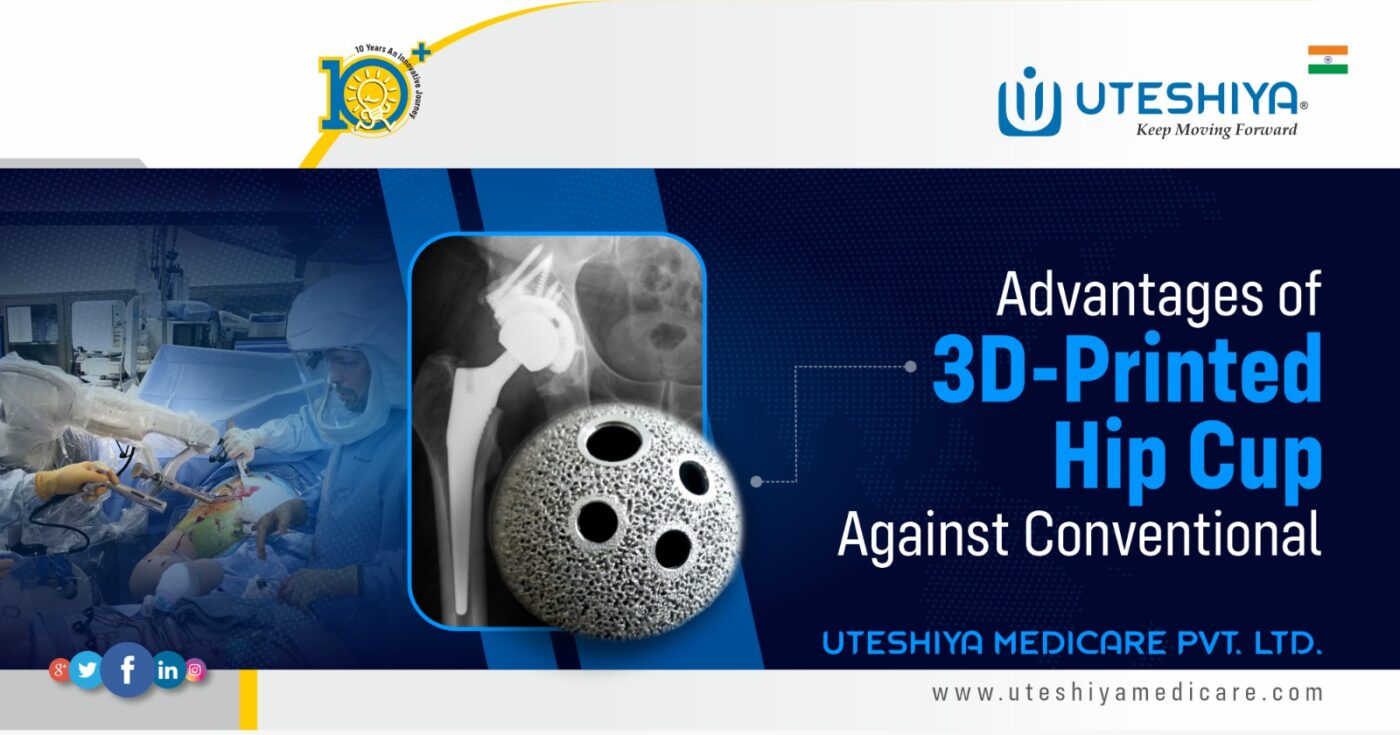
Many people have achieved great results with total hip arthroplasty (THA). However, the acetabular cup (hip) still presents several challenges, including improper bone growth, loosening, and the need for complex repairs. Additive manufacturing (AM, also known as 3D printing) has evolved from creating prototypes to producing implants that are widely used and accepted over the last decade. Modern 3D-printed acetabular components, especially those with highly porous titanium designs, clearly offer several clinical and biomechanical benefits over traditional cups. I’ll talk about these benefits, back them up with new data, and point out places where you should still be careful below.
It’s essential to understand why 3D-printed hip cups are garnering so much attention before exploring each benefit. They are distinct from other implants due to their unique design, superior surface structure, and ability to resemble real bone. These improvements help doctors fixate things better, make them more stable, and support long-term success. 3D-printed cups are quickly becoming the preferred choice for modern hip replacements because they yield more uniform results and cause fewer issues.
1. Improved osseointegration, as bone develops into the implant.
One great thing about AM cups is that they have controlled, linked porosity that resembles trabecular bone. This micro-architecture helps blood vessels proliferate and bone to grow in (osseointegration), making an adequate biological fixation that doesn’t depend on coatings or mechanical press-fit.
Animal and early human studies consistently demonstrate that 3D-printed porous titanium implants exhibit superior bone-implant contact and stronger ingrowth compared to surfaces that are plasma-sprayed or coated.
Stronger osseointegration lowers micromotion and the long-term risk of aseptic loosening, which is a significant reason for THA modification.
2. Better stability in the primary and less early migration
For better initial press-fit and fixation, surgeons can make additively made cups with graded porosity and optimized macro-geometry. Multiple studies demonstrate excellent initial stability and minimal early cup migration at short- to mid-term follow-up, which strongly correlates with long-term survival. One example is that recent clinical groups using porous 3D-printed cups reported a high early survival rate and reliable early osseointegration at 2 years.
3. Fewer corrections are made in complex cases, especially when there are significant bone defects or revisions.
It is now common to use 3D-printed cups and augments for revision THA and complex acetabular defects. A high rate of survival has been reported in systematic reviews and meta-analyses of porous titanium cups used in repair settings. This rate is usually around 90% at the short to medium-term follow-up. That performance stands out because upgrades often have to deal with weak host bones and high mechanical demands.
About 95.5% of patients who received porous acetabular implants survive the follow-up times, and their functional scores improve significantly after surgery.
4. Personalized solutions for each patient and detailed planning for surgery
CAD/CAM technology enables implants and prostheses to be genuinely unique, with forms that precisely fit the complex shape of the pelvis. Custom 3D-printed cups and supports can correct the hip center and biomechanics when there is significant bone loss or a congenital disability. Off-the-shelf parts would not work well in these cases. The use of patient-specific implants and augmentations has been shown to improve fit, reduce the need for structural grafting, and make reconstructions in severe defects more predictable.
Less improvising during surgery, faster reconstruction in complicated cases, and often fewer treatments afterward are all practical benefits.
5. Freedom in mechanical design adjusts toughness and reduces stress-shielding
You can create the lattice topology, pore size, and porosity gradient with AM to make implants stiffer and decrease stress-shielding, which is bone loss caused by implants that are too stiff. Studies in biomechanics have shown that customized porous structures can lower local stiffness while keeping strength. This could help protect periprosthetic bone over time. This level of design control isn’t possible with regular cast or machined cups.
6. Reducing the number of coatings and manufacturing stages reduces interface failure.
Porous coatings that are used today sit on top of a base shell and create a contact that can separate or wear away. 3D-printed cups that are fully porous are either made of a single piece of lattice or have porous layers that are fused together during the printing process. This makes it less likely that interfaces will break. Reports from clinical trials show that fully porous builds have good long-term fixation and low rates of coating-related problems.
What the literature says about the evidence
Early and mid-term clinical series show a high rate of survivorship (90–96% based on cohort and follow-up), with substantial improvements in how patients say they are doing and low rates of migration.
Histologic and early healing models show that bone-implant contact is higher with plasma-coated implants at 90 days compared to other implants. This supports the idea that better stability is caused by better bone contact.
Meta-analyses of porous titanium cups used in revisions find that nearly 95% of patients survive and have good functional gains. This is very amazing considering how complicated the cases were.
Concerns about limitations
Not yet available are the long-term results. Only a few of the positive studies report follow-ups in the next two to five years. Early survival is good news, but there aren’t many very long-term (>10 years) comparisons.
Look over costs and production. Implants made with 3D printers may cost more per unit and need strict quality control measures, such as handling powder, post-processing, and mechanical testing. Costs to the health system and differences in payment affect uptake.
Product variability. Different 3D-printed designs have different pore sizes, lattice patterns, and printing methods that affect how well they work. Surgeons have to trust well-known manufacturers and results that have already been released.
Wrapping It Up
When it comes to osseointegration, defect repair, and mechanical matching, 3D-printed acetabular cups make a big difference in the clinic. For primary THA, the benefits are real (better bone ingrowth and less early migration), and for revisions or complicated defects, AM is often the best choice because it lets you make custom shapes and stronger biological fixation. There are now a lot of survivorship data and clinical follow-ups that show that the short- to medium-term results are at least as good as, and often better than, traditional designs.
